STELLAR
An LLM architecture for reliable customer support, built as a directed acyclic graph of nine specialized modules and eleven predefined workflows.
Semantix AI, Mar 2024 - Aug 2025
Journal of the Brazilian Computer Society, 2026
- Specialized modules
- 9
- Predefined workflows
- 11
- Qualis rating of the journal, indexed in Scopus
- A2
- Published in JBCS, vol. 32, as first author
- 2026
One LLM call is hard to trust
When a single model call answers the customer directly, its answers are difficult to explain, a hallucination goes straight to the customer, and there is no structural place to check compliance or to decide when a person should take over.
Nine modules, eleven workflows
STELLAR (Structured, Trustworthy, and Explainable LLM-Led Architecture for Reliable Customer Support) replaces the single call with a directed acyclic graph of nine specialized modules, composed into eleven predefined workflows. Together the modules cover:
- Few-shot classification
- Retrieval-augmented generation (RAG)
- Sentiment analysis
- Urgency-aware human escalation
- Compliance verification
- User interaction validation
- Semi-automated knowledge base refinement
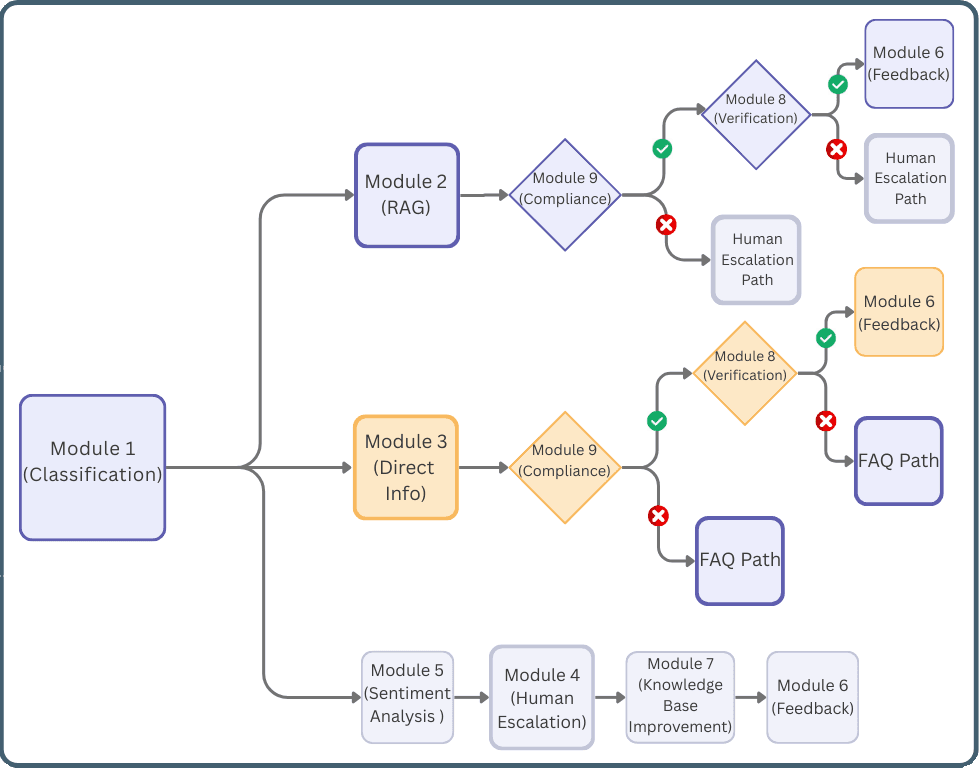
Three branches after classification
Every request starts at classification and takes one of three branches: retrieval-augmented generation, a direct-information answer, or sentiment analysis. The first two pass through compliance and verification modules, and a failure at either point sends the conversation to a person or to an FAQ path. The sentiment branch leads to human escalation, which feeds knowledge base refinement.
First-author paper in JBCS
I designed, developed and led STELLAR at Semantix AI as a production-ready architecture, then published it as first author with Hélio Pedrini in the Journal of the Brazilian Computer Society, vol. 32(1), pp. 128-144, 2026. The journal is Qualis A2 and indexed in Scopus.
Also at Semantix
Separately from STELLAR, I built a hallucination benchmark that evaluated 7 models across 90,000+ questions in English and Portuguese. I also researched RAG techniques and built data pipelines for RAG-based retrieval.