Brain MRI Pipeline
A multimodal 3D MRI pipeline for brain tumor segmentation, missing-modality synthesis and therapy response prediction, built for the BraTS 2025 Challenge.
MBZUAI, UGRIP Research Intern, Jun 2025 - Sep 2025
Supervised by Dr. Mohammad Yaqub
- Papers from the program: 1 co-first author, 2 co-author
- 3
- Average LesionWise DSC on the hidden validation set
- 0.897
- Mean ROC AUC, 4-class RANO response prediction
- 0.81
- Selected from 2,000+ international applicants
- 60
One summer at MBZUAI
UGRIP is MBZUAI's fully funded AI research program in Abu Dhabi. I was selected among the top 3% of 2,000+ international applicants, one of about 60 students. In one summer, our team built a complete 3D medical imaging pipeline for the BraTS 2025 Challenge.
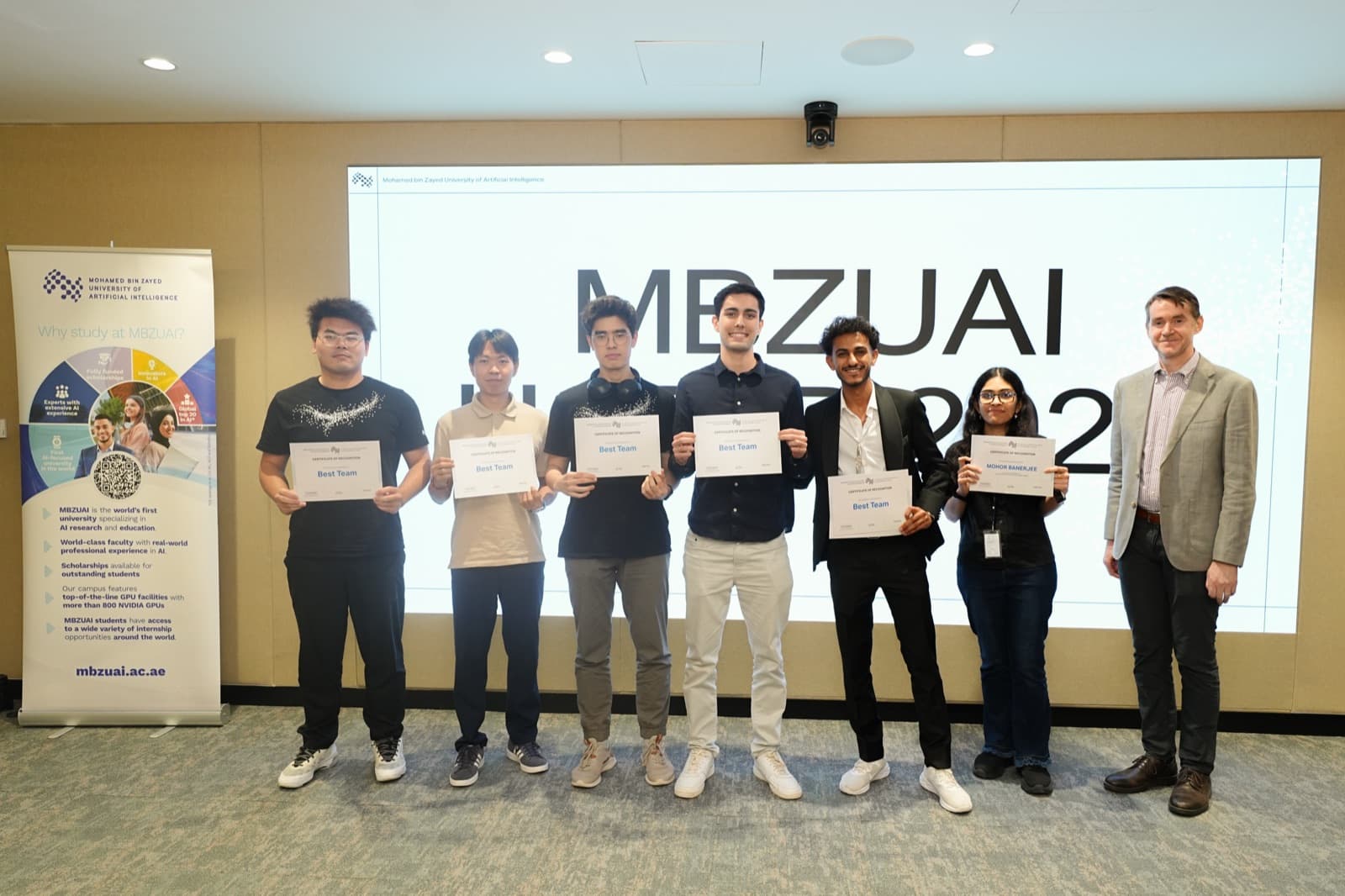
I was one of the final presenters, and the team received the Best Team Award, the top award among 15 research groups.
One paper per task
Segmentation. EMedNeXt is an enhanced MedNeXt V2 framework with deep supervision for glioma segmentation in sub-Saharan Africa. It reached an average LesionWise DSC of 0.897 on the hidden validation set and was published in Lecture Notes in Computer Science, vol. 16376, with me as co-author.
Missing-modality synthesis. MISFIT is a two-stage generative framework for cross-modality synthesis of 3D brain MRI that operates entirely in the wavelet domain, built for the BraSyn task. It was published in Lecture Notes in Computer Science, vol. 16377, with me as co-author.
Response prediction. A hybrid framework fuses fine-tuned ResNet-18 deep features with 4,800+ radiomic and clinically driven features, and a CatBoost classifier reaches a mean ROC AUC of 0.81 on 4-class RANO response prediction. I am co-first author of this paper, submitted to the BraTS-Lighthouse 2025 Challenge and available on arXiv.